Thursday, April 9, 2009

Happy Birthday Pups

Tank, our big Kangal Dog "puppy," turns two today. He tips the scale at nearly 150 pounds, but has the mind of a two month old .

Here is the litter with patient mom, Zerrin, shortly after birth, 4/9/07

We took some pictures to send to his birthday brothers and sisters:

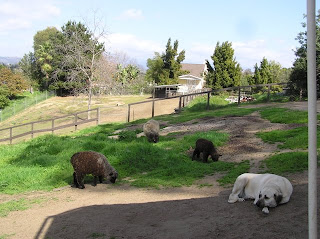
Tank thought it was going to be just another day in the goat pen, trying to look relaxed under Daisy's withering suspicion. That is until we invited the goats into HIS pen.


They wandered around for a while, checked out the empty swimming pool, and generally entertained themselves.


This gave Tank and the others a chance to check out Eddie, which is what he really wanted for his birthday. Aunt Daisy (the black angora in picture #2) generally won't let Tank near the baby.

When all was done and the goat friends returned to their pen, he was one happy fella.

Friday, April 3, 2009

15 Minutes of Fame

Well, it is more like 15 words, but still...
We recently read this nice little mention in San Diego Magazine:

To Market, To Market
Spring offers the perfect invitation to sample the bounty of our local farmers’ markets. From Vista to Little Italy, we take you to the region’s best outdoor markets, each boasting its own distinct flavor. Disclaimer: You may never want to step into a chain supermarket again.
By Adam Elder and Julia Beeson Polloreno | Photographs by Ramona D'Viola
Vista Farmers' Market

Saturday, 7:45-11 a.m. County Courthouse (325 South Melrose Drive)

The longest-running farmers’ market in the county (starting in 1981), the Vista market has a devoted following of patrons who make a visit their Saturday-morning ritual. It’s a one-stop shop with offerings that range from Jackie’s Jams to beef jerky. Within the maze of booths, you’ll find locally harvested macadamia nuts, handmade soaps from Beauty & the Bath, fresh bread from Sadie Rose, gourmet items from San Marcos–based T&H Prime Meats & Sausage and bright yellow sunflowers bursting from white buckets. Schaner Farms brings fresh citrus and oversized gourds, Gaytan Farms sells an array of vegetables, and Oakes Knoll Ranch offers Dancey tangerines and extra-large Haas avocados. One unique offering comes courtesy of Rancho Borrego Negro, a Fallbrook outfit that sells homegrown and handspun wool yarns. At this booth, a woman spins wool into yarn as onlookers pause to watch; also posted are photos of local sheep for sale, presumably belonging to the proprietor.

http://www.sandiegomagazine.com/media/San-Diego-Magazine/April-2009/To-Market-To-Market/index.php?

My only regret is that I too-quickly logged on to San Diego Magazine's web page to add a comment thanking them for the kind review and also to give a plug for the local Bonsall Farmers' Market, where we go ever Sunday and which we have been supporting since their very first day. I say "too-quickly" because shortly after I left the notice on line, I received this totally unrelated email:
The Bonsall Education Foundation and Bonsall Farmers' Market have come to a decision as a group to discontinue our relationship with you as one of our market vendors effective immediately. There have been several serious instances where we deem your conduct to be unprofessional. Such conduct seriously undermines the well-being of the market. We are disappointed that our business relationship didn?t work out. We wish you the best of luck in the future.>>

Further attempts at communication or to find out more details have remained unanswered, so I am quite as confused as you are. At any rate, I am unable to alter the comment online (which is probably a good thing!) but have since found the lovely little Leucadia/Encinitas Farmers' Market, so that is how we now spend our Sundays. We are finding it infinitely more pleasurable and profitable. If you are in the county on Sunday, stop by and see us:Leucadia/Encinitas Market 10am-2pm; Union St and Vulcan St. (Ecke Elementary).

Ah, April

True to the old homily, March went out like a lamb and April has arrived with the faintest suggestion of showers. The weeds are growing like, well, weeds, and the sheep have been moved from pasture to pasture to take advantage of the green bounty. Now all that remain are the invasive and inedible thistles, which taunt me daily to get a shovel and get down there to dig them out before they go to seed.

Mazie, our elderly Angora goat, has been standing down in the bottom corner of the goat pen, far away from the crowd. It is a nice, sandy spot in the shade of high bushes, but still, we feared that her time was drawing near. I grew a little hopeful when she moved closer up the hill to lie in the sun yesterday, and then last night we found this:


Yollie watches Mazie and the new one.

I don't think Yollie (Kangal on duty in the goat pen) even noticed the birth until we walked over, then she quickly moved to inspect the newborn and help clean it. Too bad it's a boy, because I was all set to call the kid April. Now I think he must be named Oedipus, because our pygora buck was taken out of the girls pen a loooong time ago, and the only males remaining were her twin boys from last year. Obviously one of them was quite precocious.

Sunday, March 29, 2009

Eggs and Bunnies and Wheels Left Behind

I have been spending idle moments felting some of my dyed, carded wool around plastic eggs and knitting little bunnies, hopefully to sell at the weekend markets. I call the eggs "Rare and Exotic Sheep Eggs -- colorful eggs from contented sheep," and display them in a cozy nest of curly Wensleydale locks. They are fun to make, if a bit time consuming, since they are wet felted around masking tape-covered plastic eggs.

At the market my husband loves to sit there and spin out wild stories about how our sheep first use their wool to build cozy little nests, hidden in the tall grass of the field, then secretly lay their eggs. He talks about how difficult it is to find them, because the sheep are really very smart and clever, and then goes on to tell about the teeny little baby sheep that might hatch from the eggs if the buyer takes very good care of them.


This seems to delight most children and some adults, as do the bunnies who are featured in a nest of pale green Wensleydale locks, getting ready to nibble on an organic carrot. I have knitted them a time or two over the years, but finally purchased the pattern from Jackie at Heart's Ease and asked her if it was ok to try to sell them... the operative word being "try." She was very supportive, and quite helpful, with lots of good ideas for next year, and asked that I give credit to her for the pattern.

To my surprise, several people stopped and wrote down the address for the pattern
, but not one even looked at the handspun yarn for sale, which would have made very cute bunnies if I do say so myself. So far only one dear little girl came rushing back after closing on Saturday, handed me money that had been squished in her fist, and then spent many anguished minutes trying to pick her bunny. I reassured her that she had selected the absolute best.

I thought that I had heard practically all of the possible comments and quips on spinners and spinning (including the rather ancient little old fellow who would stop and serenade me with "There's an Old Spinning Wheel in the Parlor" three or four times each morning), but the fella who exclaimed, "See what she's doing? She's making hair wigs!" to his equally clueless girl pal this morning was definitely something new.

Also new and different were the two high school boys wearing football jerseys who marched over to my rack of sheepskins and demanded to know "What are these -- placemats?" I explained that they were sheepskins, and they paused only a beat before they pointed to my wheel and asked "Do you make them on that thing?"

If people actually know what a spinning wheel is, one comment that seems to be de rigure is "Oh, my ---- [fill in the blank: grandma, mother, aunt, etc.] had one of those but I never saw her use it." I have heard this so many times, that it makes me very curious about what has happened to the hundreds, if not thouands, of unused, cast-aside spinning wheels.

Today a lady paused briefly to see what I was doing, then tossed off dismissively, "I used to do that." After a brief pause, she added, "I even used to have my own SHEEP."
Well, now, isn't that interesting. So I just had to ask, "What happened to your wheel?"
"Oh," she answered, "when I moved out from Minnnesota it didn't get packed."

All day that has bothered me. How could you not take your spinning wheel?!!! My 36" wheel was one of the few things (besides eight dogs and a cat) that we took when we were evacuated from the fires. Did her poor little wheel make it as far as the front porch, only to be overlooked by the movers? Did they leave it out in the yard, alone, in the rain? Or maybe it was left in the attic, whimpering to itself as it leaned to look out a tiny, dusty window pane and saw the truck motor off down the drive?

Thursday, March 19, 2009

Working Like a Dog

Well, yes, we did just shear a dozen fiber goats, but that isn't the reference I intended. I was thinking about the different jobs that our dogs do; what's involved, and whether or not they see it as work.

Making the rounds on some of the fiber and sheep internet lists is a wonderful video of some really skilled border collies working flocks to produce -- as the tag line says -- some amazing art.

Our 10-year-old border collie feels deprived if not allowed to be with the stock, and will run 'till her tongue hangs in the dirt if something exciting is going on. On the other hand, Sevi, one of our Kangal Dog flock guardians, is totally blase' and generally sleeps on the job. (below)
She appears to be oblivious to anything going on, but actually is quite alert. She likes to sleep at the top of the hill, where she can see all around, and will stand to get a better view if need be.


Sevi on alert. Note that the ewe is looking, too.

The sheep hardly look up, and seldom even stop chewing. The day I took these pictures, I was amazed to see her charge down the hill like a runaway freight train when she spotted a strange dog on the other side of the fence, and even more amazed to see that the sheep barely turned a hair when she roared past.
That white speck in the bottom of the pasture is Sevi, barking her warning at a would-be intruder. You can see that the grazing flock barely moved, when one would expect them to scatter to the winds at her sudden intrusion. At night her warning roars will be backed up by the other six dogs chiming in, which has been enough to keep livestock safe and sound for many years.

Several times a month Sevi and I will visit a library or a school or a retirement home, where she falls easily into her other "job," that of a therapy dog for Love on a Leash. Below Sevi listens while a young lady reads to her.


If you could see her face a bit better, you would see that her eyes are nearly shut and that she is almost smiling. Soon she will gently melt to the floor, close her eyes, stretch out on her side and fall sound asleep. Her snoring isn't much of a problem, but we all have to move when she starts running in a dream.

Like the rest of us, I am pretty sure that dogs love having a job to do, and find satisfaction in doing it. At least these big guys sure do.

Tuesday, March 17, 2009

Go West (or East, South or Midwest)

I don’t know if STITCHES West is THE best event of my year, but it is certainly one of the top five. It is always filled with joy and anxiety and stress and delight and a stunning amount of humility as I realize that I am a very small little fish in the enormous pond of knitters and fiber artists/addicts. It’s market is a thrilling extravaganza of fiber temptations, the classes are brain-bulging tests of concentration, memory and understanding, and the fiber-watching opportunities simply astound.

For the past half-dozen years I have spoiled myself with almost-annual pilgrimages to the Bay area in order to take a few classes, shop and dream at the market, ogle some beautiful knitting, and maybe have a room-service meal. For the past few years my daughter (below R, learning how to knit with a silk "hankie") has been able to meet me for a night and maybe a class, but this year she has a baby, in addition to her job, so I made time to visit grands before and after the convention.

Over the years I have enjoyed classes with Lily Chin, Chris Bylsma, Maggie Jackson (below L)

and many, many more excellent and inspiring teachers. This year I signed up for a class on Substituting Yarn, by Kellie Nuss, which was an excellent crash course in all things pattern and fiber related; a full day of spinning cotton on a charkha wheel, with Eileen Hallman; a class on making a needle-felted pet, with Sharon Costello; a refresher on spindle spinning with Merike Saarniit, and a market class on Knitting in Both Directions, or knitting back backwards. Yeah, that's it exactly -- brain twisting but interesting!

I had lunch with a friend from home, who also attended, and dropped in on the intarsia seminar, which was quite beyond me in all but the "gee whiz" respect. One experience that was totally new and fresh was being able to attend "preview" night at the market. This is the first evening of the convention, and is open only to students and teachers, so it is a great chance to actually talk with folks and take your time in a wonderfully uncrowded hall. With over 1200 booth spaces, this is a real luxury.

I was wandering around this wonderland in a total daze, when I finally stopped in at a very nice booth called Urban Fauna. It was chocked full of interesting stuff, and had beautiful skeins of handspun yarn done by various artists hanging on the back wall, so of course I had to go look. I stepped over a new Mach I spinning wheel, but on the way out stopped to watch as another lady sat down to try it out. I was surprised to find that it was made just 30 or 40 miles from where I live, and surprised again to learn that the lady trying it out was Eileen Hallman, the instructor for my charkha class the following day. I told her that I was looking forward to the class because I had a bag of brown cotton, given to me by an elderly gentleman at one of the farmer's markets that I wanted to learn to spin. Really? She wanted to know what city the market was in, and when I told her that it was a small little spot, she became very insistent on knowing the name. Vista, I told her, in northern San Diego county.

She stared at me with her mouth open, and said, "I know where it is; I used to live there. Those plants could be from my yard!!" We eagerly started reminiscing. I told her I had an old spinning friend who used to live on the same street; she not only knew her, but had learned to spin cotton there. And then the kicker. She looked at my name tag and muttered "Fallbrook ... I used to go spin with a group at someone's house there, but her name wasn't Lambert." "Yeah," I said, "I remarried." Well, to say we were both gobsmacked would not do it justice. It was a kick.

I brought my baggie of cotton to the class, bought a charkha book wheel from her (she owns and runs New World Textiles, in NC) and was so busy learning to use it that I forgot about the raw

The book charkha, opened (left) and white (Pima), green and "mauve" raw cotton (right).

brown cotton until break. At that point, Eileen picked up the bag and rushed over to hold it under a light. She did one of those comedy-skit double-takes -- looking at me, then the bag, then back to me again -- and finally said, "You don't know what you have here." I agreed, shaking then nodding my head: I had no clue. "This isn't brown cotton, she continued, "this is MAUVE cotton." She went on to tell me how rare it was, and even in Peru was becoming impossible to find , let alone export. "Are you sure you want to give me the whole bag?" she finally asked. I gave in to baser instincts, worried that my little supplier might never return to the market, and gave her half. But I think we both were quite happy, with our cotton and our discoveries.

The needle felting class was great fun, but I sort of complicated things by bringing pictures of my sheep instead of a dog or a cat. When she said, "All of you who are doing dogs sit on this side, and all of you who are doing cats sit on the other side," I knew I was in trouble. Still, I think I learned enough to be able to complete my 'omage to Gwendolynn ... one of these days.

Gwendolynn, immortalized in needle felt, from her own wool.

It was a wonderful three days that recharged my batteries and have given me a massive dose of enthusiasm.

And don't even get me started on the darling grand daughters!

Bay area babes: Lalima (6 months) and Kavina (9 months).

Next: Sheep eggs, etc.

Thursday, February 12, 2009

Happy Birthday to Us

Happy Birthday, Misters Darwin and Lincoln

You guys have chalked up 200, I just 65; certainly no comparison in any respect. Still, I suppose that some words are in order to commemorate the completion of one’s 65th year on this planet, no matter how inconsequential they have been. Once you start hitting birthdays that sound like speed-limits, thoughts naturally tend toward death and impermanence, but mine seemed to be focused on killing.

I have killed countless things over the decades: dreams, ideas, and hopes as well as living creatures. Some were dispatched inadvertently, by accident, some carelessly or thoughtlessly, and some with premeditated, deadly intention. Gwendolyn’s death was one of these.


Gwendolyn ready for her close-up, or shearing

Gwendolyn was a beautiful white Wensleydale/Cotswold ewe that began her life in Colorado in 2002. Along with Wallit, the black Wensleydale/Cotswold ram we had purchased a few years earlier, she was to be the foundation of our new flock of luster longwools. She was friendly and charming, with the most wonderful spinning wool. After a year or two we bred her to Wallit, and in the spring she produced a big, black single ewe lamb that was named Precious, after the character in McCall Smith’s wonderful #1 Ladies Detective Agency books. Being an only child, she was everyone’s delight. Though we had other sheep and other lambs, she was the favorite.

When Precious was a few months old, and starting on solid food, she somehow ingested a piece of wire that was hidden in the hay, and died of peritonitis. It was a sad day for all of us. We had hopes or repeating the breeding the following year, but Wallit sickened and died before that could be achieved, so Gwendolyn was bred to another ram. The lambs were cute -- white twins, Gwynneth and Gwain -- but just not the same as our beloved Wensleydale cross.


Gwendolyn introduces Gwynneth (behind her) to one of the Kangal pups.

We took a year or two off from having lambs, but the springs were too quiet and the fields too empty without lambs bounding about, so last summer I bought another black Wensleydale ram and three lambs. They were shipped down from Oregon, and arrived after quite a long and arduous trip, but the ram was feeling well enough to get busy with all of the girls, including Gwendolyn.

Unfortunately, once that job was done, he focused primarily on eating, and on being the first in line, even if it meant bashing his ladies out of the way. Unfortunately, gentle Gwendolyn was one of his victims, and suffered injury to her hip, which left her severely lame. Still, we had hopes that she could carry her lamb(s) to term with proper care, so set her up in “the infirmary” (see the picture below under the Mattie story) and gave her daily special attention until one day last month she finally lambed. There was one huge lamb, dead in the sack, but another sprightly little black one happily bouncing about… and it was a girl! The good news was that Gwendolyn seemed to be feeling better (wouldn’t you?) and was dutifully standing so that the lamb could nurse. Such a good mom, such a lovely lamb. I should not have named her Precious, but I did.

The little family did surprisingly well. Despite the fact that Gwendolyn seemed to be growing steadily weaker, she could still stand when the baby wanted to nurse, and both ate like champs. We put them back in with the other sheep so that the lamb would have playmates, but Gwendolyn's increasing frailty and several days of icy rains led us to finally put her in a separate pen, so that she and the lamb would not be unduly jostled by the rest of the flock. It was just a day later that we found Gwendolyn collapsed on top of the still-warm body of her lamb, unable or unwilling to get up.

It was clear that the kindest thing would be to put her down, but I just could not do it on my birthday. Or the next day, or the next. Eventually I was ready, so husband and I went out to the sheep pen. He started digging a hole while I gave Gwendolynn some grain and thanked her for her life and her lambs and her wool. Then I gave her a good dose of Banophen, and put a bag over her head, holding her until she quit breathing.

We burried Gwendolyn with her lamb at her side, and only later did it occur to me that they both died the same way: smothered by someone who loved them.


Requiescat in pace et in amore.